Was going through some old files and came across an old favorite by Joe Ceravolo that I had typed up.
Grow
by Joseph Ceravolo
I fight and fight.
I wake up.
The oasis is now dark.
I cannot hear anything.
The wind is felt
and the stars and the sand
so that no one
will be taken by pain.
I sit next to the bushes,
Hercules couldn’t move me,
and sleep and dream.
The sand, the stars are solid
in this sleeping oasis,
alone with the desert and
the metaphysical cigarette.
Showing posts with label joseph ceravolo. Show all posts
Showing posts with label joseph ceravolo. Show all posts
Monday, April 25, 2011


Sunday, August 24, 2008
Passion for the Sky
by Joseph Ceravolo
You are near me. The night
is rectilinear and light
in the new lipstick
on your mouth and on the colored
flowers. The irises are blue.
As far as I look we are across. A
boat crosses by. There is no monkey in me
left: sleep. There is something
sold, lemons. Corn is whizzing from the
ground. You are sleeping
and day starts its lipstick.
Where do we go from here?
Blue irises.
You are near me. The night
is rectilinear and light
in the new lipstick
on your mouth and on the colored
flowers. The irises are blue.
As far as I look we are across. A
boat crosses by. There is no monkey in me
left: sleep. There is something
sold, lemons. Corn is whizzing from the
ground. You are sleeping
and day starts its lipstick.
Where do we go from here?
Blue irises.
Monday, August 27, 2007
mentions / Paul Blackburn
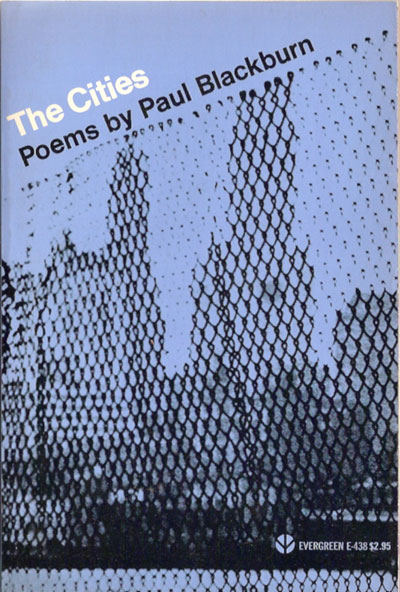
As I've mentioned before, it's great to see all of the attention Joe Ceravolo's poetry has been getting lately. It probably won't lead to a Complete or Collected anytime soon, but it's nice to see he has many passionate fans out there. Most of the time when I mentioned him to someone as one of my favorites in the mid or late ’90s, it was almost certainly "Joe who?" A few years ago when I was posting "to" Jack Spicer, he seemed like he was slipping from his one-time relatively prominent place in the minds of those working in the "New American Poetry" traditions. That trend, too, has been reversed in recent years. What should happen next is to get more people talking again about Paul Blackburn. And UC, or somebody, should put his Collected Poems back in print—a used copy will set you back $85 at Amazon. His poems can be "crude" at times and that's likely to keep him from gaining a "general audience," not willing to see past it—or even better, deal with it—and recognize his technical mastery, embedded and not flaunted. He wrote with a bluntness that's refreshing in poetry, but not necessarily welcome. Anyway, got to get ready for work now. Here's a poem of his, a gentleness, from The Cities.
The Art
by Paul Blackburn
to write poems, say,
is not a personal achievement
that bewilderment
On the way to work
two white butterflies
& clover along the walks
to ask .
to want that much of it .
The Art
by Paul Blackburn
to write poems, say,
is not a personal achievement
that bewilderment
On the way to work
two white butterflies
& clover along the walks
to ask .
to want that much of it .
Thursday, August 02, 2007
Octopus 9
The latest issue of Octopus is up and contains an appreciation of Joe Ceravolo's Transmigration Solo. To commemorate the occasion, here's a poem from that collection. I like the simple, child-like diction. The progression of the observations from external to internal, and their confluence together with the somewhat Ashberian shifting of pronouns: the poem has its "we" section, its "I" section, and its "you" section. And Joe's trademark innocence-filled questions create their typical pleasant surprise (here not quite achieving the kōan-like quality they sometimes do in his poems).
SPELL OF ETERNITY
Joe Ceravolo
We are going to the park.
There are swings there.
There are rocks along a sand bed.
The flowers rest along
the bed. The flowers
rise among the fatigued
insects invading them.
There is a smell.
It invades us
through the insects
and makes us
notice there are flowers along
the bed, tiny flower clusters.
I envy the smell along the beds.
Is this a decaying soul? But
it is not said.
Am I decaying like
autumn insects, autumn leaves?
Find my heart!
Revive it! The old clouds
you find along the sky
have no chance next to you,
because it is autumn,
autumn.
SPELL OF ETERNITY
Joe Ceravolo
We are going to the park.
There are swings there.
There are rocks along a sand bed.
The flowers rest along
the bed. The flowers
rise among the fatigued
insects invading them.
There is a smell.
It invades us
through the insects
and makes us
notice there are flowers along
the bed, tiny flower clusters.
I envy the smell along the beds.
Is this a decaying soul? But
it is not said.
Am I decaying like
autumn insects, autumn leaves?
Find my heart!
Revive it! The old clouds
you find along the sky
have no chance next to you,
because it is autumn,
autumn.
Friday, July 06, 2007
The Real JC
A whole lotta love going on at the Poetics List for the real JC, Joseph Ceravolo. In 2004 I blogged a little on JC and also posted a rare poem of his. In the spirit of what's shaking now, here's another bootleg from his unpublished manuscript Mad Angels:
SONNET
by Joseph Ceravolo
In the midde of Autumn
early when the skies
show the dawn
still hovering in trees
and the geese, a series
of arrows break form
for another unknown bird
that catches our eyes,
I can't return.
While overhead one storm
in the bird's neck feathers carries
the dampness of the journey
soaked with our laughs and whispers
in the subterfuge of happiness.
SONNET
by Joseph Ceravolo
In the midde of Autumn
early when the skies
show the dawn
still hovering in trees
and the geese, a series
of arrows break form
for another unknown bird
that catches our eyes,
I can't return.
While overhead one storm
in the bird's neck feathers carries
the dampness of the journey
soaked with our laughs and whispers
in the subterfuge of happiness.
Thursday, July 22, 2004
Hymn to Rain
by Joe Ceravolo
Again rain on the evolved leaves.
Rain in the jungle forest
where people tend the garden
or hunt the monkey.
Rain where people pound the pavement
and wet trucks rest
after a flashing night.
Rain that dissolves the mount
or fills the valley
or breaks the dam
or wakes the face
washes the hair
stiffens the organ.
Rain that dissolves the dreams
or creates the dreams
in atmospheric phantoms.
O, praise be rain, praise be mist
praise be fish deep and dark,
praise be stirring ocean
and starting wind,
and kinematic waves
in altered motion.
Rain before life, rain before
death
Praise be rain again, rain again praise!
Again rain on the evolved leaves.
Rain in the jungle forest
where people tend the garden
or hunt the monkey.
Rain where people pound the pavement
and wet trucks rest
after a flashing night.
Rain that dissolves the mount
or fills the valley
or breaks the dam
or wakes the face
washes the hair
stiffens the organ.
Rain that dissolves the dreams
or creates the dreams
in atmospheric phantoms.
O, praise be rain, praise be mist
praise be fish deep and dark,
praise be stirring ocean
and starting wind,
and kinematic waves
in altered motion.
Rain before life, rain before
death
Praise be rain again, rain again praise!
Monday, July 19, 2004
Searching for Joe Ceravolo
I was introduced to the work of Joseph Ceravolo (1964–1988) in the summer of 94. The American Poetry Review reprinted a generous selection of poems, along with an introduction by Kenneth Koch, from the then forthcoming The Green Lake Is Awake: Selected Poems. Although I had only been reading poetry for little more than two years at that point, I did have some experience with avant-garde poetries,* primarily via Rothenberg's Revolution of the Word, Kerouac’s Mexico City Blues, Sulfur, New American Writing, O!!Zone, and Exquisite Corpse. Still I had never come across any poems quite like Ceravolo's before. Poems with language so familiar, so often simple, it was actually child-like, yet that still managed to render everyday emotions in their true complexity. A poet of “Everyday Life” in all of its extraordinariness—if we would just slow down to see it. Which is one of the things Ceravolo's poetry does best: slow us down.
Why does light diffuse
As earth turns away from the sun?
I want to give my food
To a stranger. I want
to be taken.
What kind of a face do
I have while leaving?
I'm thinking of my friend.
(from "The Wind Is Blowing West"
in The Green Lake Is Awake)
Now, ten years after the publication of The Green Lake, Ceravolo's work is again receiving deserved attention. This time it comes from Fence magazine (Spring/Summer 2004), where six poems are reprinted along with a short "appreciation" by Anthony Hawley. It's a significant event because Ceravolo is on the verge of being lost. As Hawley explains, it's nearly impossible to track down Ceravolo's books. The Fence selections come from two "VERY hard to come by" volumes, Wildflowers Out of Gas (1967) and Millennium Dust(1982). Though generally not up to the level of The Green Lake poems, they do have the same energy. An energy derived largely from a clipped/Cubistic syntax ("He played with / He put canoe in river, strong eyes // like a rainbow / declines to go play"). Also present are Ceravolo's almost trademark interrogatives, which Clayton Eshleman once described as, “fall[ing] somewhere between ‘koans’ and maddening 4-year-old questions,” such as "Can I ever fade people?" and "Does a fly need to be / ugly?" These poems left me with that old familiar feeling of wanting more.
A few months passed after my “discovery” of Ceravolo until, in the fall of 94, I found more of his work in John Bernard Myers' The Poets of the New York School and Padgett and Shapiro's Anthology of New York Poets. Soon after, I picked up The Green Lake, but that was it for a while.
One poem I had expected to see in The Green Lake, but did not appear, was "Wounded Deer" which ends: "In what hungry woods / should I be walking to get hit / and killed? To be born / like a fire that went out." It's perfect really. Read aloud, the lines sound of staggering, which reinforces the imagery, and the use of the interrogative helps C approach material that could easily be sentimental. Also, the paradoxical last line, which I dare say would scalp ol' Emily D., besides offering a new take on the life-death continuum, echoes Tu Fu: "Borne headlong.../// Life whirls past like drunken wildfire (from "Winter Dawn", trans. Rexroth).
A couple years later, working for a bookstore, I noticed that Transmigration Solo could still be ordered. Surpirsed, I gave it a shot, not wholly confident it would arrive, as other listed books I'd tried to order by Ted Berrigan and Sotère Torregian were no-gos. But, in a couple weeks, I had received not just any copy, but a numbered and signed copy. Not usually the kind of person who gets excited about signed paraphenalia, I have to admit I thought this one was pretty cool. But in the years since, there's not much else of C's that I've been able to find, just Spring in This World of Poor Mutts, which I had already read through interlibrary loan (but found at a book sale for a dollar!), and o•blek 5.
In the spring of 1989, o•blēk printed posthumously seven poems by Ceravolo. The pieces are presented as “from Mad Angels,” which to my knowledge has never been published. For all I know it was never completed, but this is some of the best work not to find it's way into The Green Lake. These poems, like the ones in Fence, force the question: When will there be a collected poems? If we're getting Berrigan’s in 2005, could C’s be far behind? Yeah, unfortunately, it could. Rather than clumsily comment, as I have above, on the poems from Mad Angels, I will simply post one. Tomorrow or the next day.
________
* There's no right word for what I mean here. "Alerntaive" and "otherstream" marginalize themsleves and yield ground to official verse culture. "Postmodern" is sloppy from overuse, and anyway wouldn't really fit the Rothenberg anthology. "Post-avant" also would be historically inaccurate here. And as far as "experimental," for which I have much sympathy as shorthand, it really doesn't say much if we follow Stevens's lead (to paraphrase): every poem is an experiment. So I stick with the loose-fitting "avant-garde"—at least for the above instance.
Why does light diffuse
As earth turns away from the sun?
I want to give my food
To a stranger. I want
to be taken.
What kind of a face do
I have while leaving?
I'm thinking of my friend.
(from "The Wind Is Blowing West"
in The Green Lake Is Awake)
Now, ten years after the publication of The Green Lake, Ceravolo's work is again receiving deserved attention. This time it comes from Fence magazine (Spring/Summer 2004), where six poems are reprinted along with a short "appreciation" by Anthony Hawley. It's a significant event because Ceravolo is on the verge of being lost. As Hawley explains, it's nearly impossible to track down Ceravolo's books. The Fence selections come from two "VERY hard to come by" volumes, Wildflowers Out of Gas (1967) and Millennium Dust(1982). Though generally not up to the level of The Green Lake poems, they do have the same energy. An energy derived largely from a clipped/Cubistic syntax ("He played with / He put canoe in river, strong eyes // like a rainbow / declines to go play"). Also present are Ceravolo's almost trademark interrogatives, which Clayton Eshleman once described as, “fall[ing] somewhere between ‘koans’ and maddening 4-year-old questions,” such as "Can I ever fade people?" and "Does a fly need to be / ugly?" These poems left me with that old familiar feeling of wanting more.
A few months passed after my “discovery” of Ceravolo until, in the fall of 94, I found more of his work in John Bernard Myers' The Poets of the New York School and Padgett and Shapiro's Anthology of New York Poets. Soon after, I picked up The Green Lake, but that was it for a while.
One poem I had expected to see in The Green Lake, but did not appear, was "Wounded Deer" which ends: "In what hungry woods / should I be walking to get hit / and killed? To be born / like a fire that went out." It's perfect really. Read aloud, the lines sound of staggering, which reinforces the imagery, and the use of the interrogative helps C approach material that could easily be sentimental. Also, the paradoxical last line, which I dare say would scalp ol' Emily D., besides offering a new take on the life-death continuum, echoes Tu Fu: "Borne headlong.../// Life whirls past like drunken wildfire (from "Winter Dawn", trans. Rexroth).
A couple years later, working for a bookstore, I noticed that Transmigration Solo could still be ordered. Surpirsed, I gave it a shot, not wholly confident it would arrive, as other listed books I'd tried to order by Ted Berrigan and Sotère Torregian were no-gos. But, in a couple weeks, I had received not just any copy, but a numbered and signed copy. Not usually the kind of person who gets excited about signed paraphenalia, I have to admit I thought this one was pretty cool. But in the years since, there's not much else of C's that I've been able to find, just Spring in This World of Poor Mutts, which I had already read through interlibrary loan (but found at a book sale for a dollar!), and o•blek 5.
In the spring of 1989, o•blēk printed posthumously seven poems by Ceravolo. The pieces are presented as “from Mad Angels,” which to my knowledge has never been published. For all I know it was never completed, but this is some of the best work not to find it's way into The Green Lake. These poems, like the ones in Fence, force the question: When will there be a collected poems? If we're getting Berrigan’s in 2005, could C’s be far behind? Yeah, unfortunately, it could. Rather than clumsily comment, as I have above, on the poems from Mad Angels, I will simply post one. Tomorrow or the next day.
________
* There's no right word for what I mean here. "Alerntaive" and "otherstream" marginalize themsleves and yield ground to official verse culture. "Postmodern" is sloppy from overuse, and anyway wouldn't really fit the Rothenberg anthology. "Post-avant" also would be historically inaccurate here. And as far as "experimental," for which I have much sympathy as shorthand, it really doesn't say much if we follow Stevens's lead (to paraphrase): every poem is an experiment. So I stick with the loose-fitting "avant-garde"—at least for the above instance.
Subscribe to:
Posts (Atom)