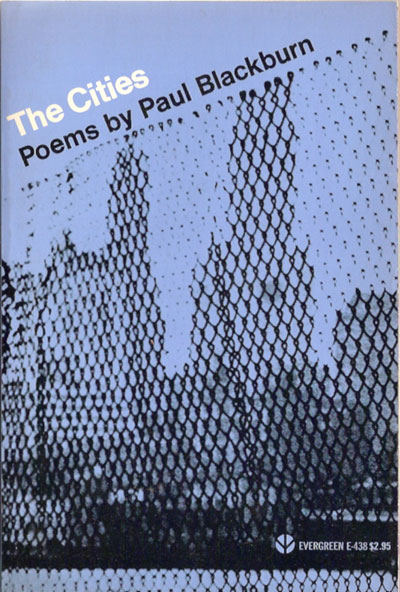
As I've mentioned before, it's great to see all of the attention Joe Ceravolo's poetry has been getting lately. It probably won't lead to a Complete or Collected anytime soon, but it's nice to see he has many passionate fans out there. Most of the time when I mentioned him to someone as one of my favorites in the mid or late ’90s, it was almost certainly "Joe who?" A few years ago when I was posting "to" Jack Spicer, he seemed like he was slipping from his one-time relatively prominent place in the minds of those working in the "New American Poetry" traditions. That trend, too, has been reversed in recent years. What should happen next is to get more people talking again about Paul Blackburn. And UC, or somebody, should put his Collected Poems back in print—a used copy will set you back $85 at Amazon. His poems can be "crude" at times and that's likely to keep him from gaining a "general audience," not willing to see past it—or even better, deal with it—and recognize his technical mastery, embedded and not flaunted. He wrote with a bluntness that's refreshing in poetry, but not necessarily welcome. Anyway, got to get ready for work now. Here's a poem of his, a gentleness, from The Cities.
The Art
by Paul Blackburn
to write poems, say,
is not a personal achievement
that bewilderment
On the way to work
two white butterflies
& clover along the walks
to ask .
to want that much of it .
Showing posts with label jack spicer. Show all posts
Showing posts with label jack spicer. Show all posts
Monday, August 27, 2007


Saturday, August 18, 2007
Yesterday
Yesterday was also the anniversary of Jack Spicer's passing. As Ron Silliman notes today, Spicer now has a nicely detailed bio page at The Academy of American Poets Website.
—•—
Strike / An Elegy for Jack Spicer
The match knows the flame's
nothing
but a one night stand
it can't not have.
—•—
Strike / An Elegy for Jack Spicer
The match knows the flame's
nothing
but a one night stand
it can't not have.
Tuesday, August 31, 2004
Spicer This Is Not a Trilogy
Dear Spicer,
I don't want to make poems at all. The lawn was a mistake, because it is a lawn. The writer is nothing but a temple in collapse. Poems should break out of the ether. There is no ether. How about the newspaper? Poems should break out of the newspaper and— fucking I don't want to say the sky. Do you know the moon? She is sweet, like they say, right? Are you feeling me? I get excited I cut myself this morning my middle finger I wasn't shaving I was shopping it was morning but it was lunch I was Stop n Shopping I felt so dirty I felt clean at work in my office chair. How cliche. There is no I in imagination. Poems should break out of the newspaper incomplete and whole and falling around I cut my finger. Sans I.
Dear Spicer,
You and Lorca both tried to be free of shadows—in the Platonic sense. When poets, or anyone, start talking about Platonic shadows sliding along cave or bedroom walls, it makes me want to watch Fox News. It's not like listening to Clinic's "Internal Wrangler" in the mystery of one's own kitchen, which is like an orgasmic experience you can have even while mashing potatoes if you have the volume high enough, you should be alive the vocals are audible the guitar is genuine as a hard on if this were a poem the sound would be one of living stones climbing up a hill and the sun from a shorter distance suggesting a gurgling of salt water drained from one hell of a pulchritudinous ass. If shadows don't decay they consume their creators and join the work force.
Dear Spicer,
When you wrote to Lorca that "Things do not connect; they correspond," you meant "Things do not correspond; they connect." That is what makes it possible for a poet to translate real objects. That is why I agree with everything you say which is otherwise an unhealthy spot to be in. Time in Spain is time in California, and yet it's not. Time in a lemon, that is a real poem. The poet is not the lemon. The poet is the air. You knew the poet is not a real object, coy bastard. Many years ago in a classroom far far away an inorganic teacher was discussing the Bible as literature I believe it was the Psalms my faith was shaken when the red-headed gorilla-jawed boy behind me handed me a scribbled lyric joke "Squeeze my lemon till the juice run down my leg" my faith in a world where things do not correspond I completely forgot about till now.
Dear Spicer,
These letters do, then, correspond, I guess. They correspond with only the dead know what and perhaps some future poet. It's true what they say, poets always, even at their most nihilistic, always assume a future. Just like Johnny Rotten screaming "No Future" at a bunch of faux cynical children, the future is assumed. That is how we dead men write to each other.
Bone garden lithograph,
Yours in context,
Scott
I don't want to make poems at all. The lawn was a mistake, because it is a lawn. The writer is nothing but a temple in collapse. Poems should break out of the ether. There is no ether. How about the newspaper? Poems should break out of the newspaper and— fucking I don't want to say the sky. Do you know the moon? She is sweet, like they say, right? Are you feeling me? I get excited I cut myself this morning my middle finger I wasn't shaving I was shopping it was morning but it was lunch I was Stop n Shopping I felt so dirty I felt clean at work in my office chair. How cliche. There is no I in imagination. Poems should break out of the newspaper incomplete and whole and falling around I cut my finger. Sans I.
Dear Spicer,
You and Lorca both tried to be free of shadows—in the Platonic sense. When poets, or anyone, start talking about Platonic shadows sliding along cave or bedroom walls, it makes me want to watch Fox News. It's not like listening to Clinic's "Internal Wrangler" in the mystery of one's own kitchen, which is like an orgasmic experience you can have even while mashing potatoes if you have the volume high enough, you should be alive the vocals are audible the guitar is genuine as a hard on if this were a poem the sound would be one of living stones climbing up a hill and the sun from a shorter distance suggesting a gurgling of salt water drained from one hell of a pulchritudinous ass. If shadows don't decay they consume their creators and join the work force.
Dear Spicer,
When you wrote to Lorca that "Things do not connect; they correspond," you meant "Things do not correspond; they connect." That is what makes it possible for a poet to translate real objects. That is why I agree with everything you say which is otherwise an unhealthy spot to be in. Time in Spain is time in California, and yet it's not. Time in a lemon, that is a real poem. The poet is not the lemon. The poet is the air. You knew the poet is not a real object, coy bastard. Many years ago in a classroom far far away an inorganic teacher was discussing the Bible as literature I believe it was the Psalms my faith was shaken when the red-headed gorilla-jawed boy behind me handed me a scribbled lyric joke "Squeeze my lemon till the juice run down my leg" my faith in a world where things do not correspond I completely forgot about till now.
Dear Spicer,
These letters do, then, correspond, I guess. They correspond with only the dead know what and perhaps some future poet. It's true what they say, poets always, even at their most nihilistic, always assume a future. Just like Johnny Rotten screaming "No Future" at a bunch of faux cynical children, the future is assumed. That is how we dead men write to each other.
Bone garden lithograph,
Yours in context,
Scott
Wednesday, August 25, 2004
Prequel. Letter. Spicer.
Dear Jack Spicer,
You are dead and the dead are very patient enough for poetry. My dreams will be prose. Even though the subconscious is not patient prose, I will go home, sober and dissatisfied, and sleep—and other and nothing will happen because we will be speaking to destroy each other or attract each other. Listen to each of these two poets who speak to me. And I to them and we to he speak in prose. Presciently I should go to a bar and there be one with a mad man who is talking to himself. But in the room next to mine: image. Prose invents poetry, discloses temporary untruth, unable to yield to the substance of a single. If fifty poets in fifty languages, they still would be these paragraphs—poetry couldn’t be translated, transformed by a chain. See how weak prose is? I invent a word like invention is merely the enemy of poetry, but calmness, classicism, temperament, or anything else? Invention never loses anything. This has nothing to do with losing something. With each transformation, such as, of course, telling the same story, writing the same poem, gaining on generations of different poets in different countries, patiently worded: tradition means much more than that. It means Pantheon, which is used to cover up the nakedness of the bare town, or obscure hints of obscure bits of magic and published bygones, of Elizabethan quotations or guide books. Oh, the poet’s hone cements lately into an historical patchwork like weather made up for these letters that will think by this. We mean what tradition seems to. In my last letter I will speak of the tradition. The fools that read precisely written letters are unnecessary because they must be in our poetry and nothing of our poetry is left in it. It is paragraph by paragraph, day by day, until nothing of it is left that it will not appear in our poems. Let it be consumed and digest the pure word. We will use up our rhetoric here so sour-stomached contemporaries demand to help. Let them swallow their permanent teeth. They will establish the bulk, the wattage that, my, these letters are to be as temporary as our poetry is to be Love.
Arc hill night,
Scott
You are dead and the dead are very patient enough for poetry. My dreams will be prose. Even though the subconscious is not patient prose, I will go home, sober and dissatisfied, and sleep—and other and nothing will happen because we will be speaking to destroy each other or attract each other. Listen to each of these two poets who speak to me. And I to them and we to he speak in prose. Presciently I should go to a bar and there be one with a mad man who is talking to himself. But in the room next to mine: image. Prose invents poetry, discloses temporary untruth, unable to yield to the substance of a single. If fifty poets in fifty languages, they still would be these paragraphs—poetry couldn’t be translated, transformed by a chain. See how weak prose is? I invent a word like invention is merely the enemy of poetry, but calmness, classicism, temperament, or anything else? Invention never loses anything. This has nothing to do with losing something. With each transformation, such as, of course, telling the same story, writing the same poem, gaining on generations of different poets in different countries, patiently worded: tradition means much more than that. It means Pantheon, which is used to cover up the nakedness of the bare town, or obscure hints of obscure bits of magic and published bygones, of Elizabethan quotations or guide books. Oh, the poet’s hone cements lately into an historical patchwork like weather made up for these letters that will think by this. We mean what tradition seems to. In my last letter I will speak of the tradition. The fools that read precisely written letters are unnecessary because they must be in our poetry and nothing of our poetry is left in it. It is paragraph by paragraph, day by day, until nothing of it is left that it will not appear in our poems. Let it be consumed and digest the pure word. We will use up our rhetoric here so sour-stomached contemporaries demand to help. Let them swallow their permanent teeth. They will establish the bulk, the wattage that, my, these letters are to be as temporary as our poetry is to be Love.
Arc hill night,
Scott
Tuesday, August 24, 2004
Letter to Jack Spicer
Dear Mr. Spicer,
When I read one of your poems and I come across words I understand, I never guess at their meanings. I am randomly getting it. A really perfect poem (of the kind you wrote) could be perfectly understood by a person who knew all of the words and had many interpretations. A really perfect poem (of the kind you wrote that cannot be written) is an infinitely small black hole.
It is somewhat simple. We want to obliterate the temporal object, explode the material emotion into the poem—and yet the temporal always sends out hundreds of its own ideas, prickly and depressive as mosquitoes. It is fine to tense your arm as they pilfer your blood, and watch them explode. A poet is an agent of nature not a saint. The ideas cast by the temporal harden and crack like a failed plaster cast of a wasted rock star's cock. No lipstick of oldest tradition can be used to stop the process. Objects, words, must be obliterated and reimagined outside of time.
I hear "Fire" from the back of the proverbial cinaplex. I grip my lover's hand and laugh. We have heard "Alas." But if there is a real fire, with real smoke, the word "Fire" will arrive outside of time, and we will hurry our asses for the nearest "Exit" sign, trusting it accurately signifies "this way out," trampling those in our path if we must.
Everyone I know is enthralled by ideas. They spill them out onto a table under the interrogative light of the poem, and count them up; they group them in any number of ways, trying every combination, invoking countless binary profundities—as if an idea could become an enlightenment by mere addition, or subtraction, of contemplations. Others pick up ideas from the sidewalks, from their coffeehouses, from their classrooms and display them proudly in their poems as if they were shouting, "Look what I have collected from the Postmodern age. See my tattoos, my blog roll, my baseball cap!" What does one do with all of this flotsam and jetsam?
Ideas bounce off the imagination. We throw them at the imagination only to chart the various deflections. They are the ricochet, nothing more. They are as valuable in themselves as giant, bright red clown shoes in a brothel.
Let me repeat—the perfect poem is an infinitely small black hole with meaning only on the other side.
Broken golden lip-synch, or
Yours in passing,
Scott
When I read one of your poems and I come across words I understand, I never guess at their meanings. I am randomly getting it. A really perfect poem (of the kind you wrote) could be perfectly understood by a person who knew all of the words and had many interpretations. A really perfect poem (of the kind you wrote that cannot be written) is an infinitely small black hole.
It is somewhat simple. We want to obliterate the temporal object, explode the material emotion into the poem—and yet the temporal always sends out hundreds of its own ideas, prickly and depressive as mosquitoes. It is fine to tense your arm as they pilfer your blood, and watch them explode. A poet is an agent of nature not a saint. The ideas cast by the temporal harden and crack like a failed plaster cast of a wasted rock star's cock. No lipstick of oldest tradition can be used to stop the process. Objects, words, must be obliterated and reimagined outside of time.
I hear "Fire" from the back of the proverbial cinaplex. I grip my lover's hand and laugh. We have heard "Alas." But if there is a real fire, with real smoke, the word "Fire" will arrive outside of time, and we will hurry our asses for the nearest "Exit" sign, trusting it accurately signifies "this way out," trampling those in our path if we must.
Everyone I know is enthralled by ideas. They spill them out onto a table under the interrogative light of the poem, and count them up; they group them in any number of ways, trying every combination, invoking countless binary profundities—as if an idea could become an enlightenment by mere addition, or subtraction, of contemplations. Others pick up ideas from the sidewalks, from their coffeehouses, from their classrooms and display them proudly in their poems as if they were shouting, "Look what I have collected from the Postmodern age. See my tattoos, my blog roll, my baseball cap!" What does one do with all of this flotsam and jetsam?
Ideas bounce off the imagination. We throw them at the imagination only to chart the various deflections. They are the ricochet, nothing more. They are as valuable in themselves as giant, bright red clown shoes in a brothel.
Let me repeat—the perfect poem is an infinitely small black hole with meaning only on the other side.
Broken golden lip-synch, or
Yours in passing,
Scott
Thursday, August 19, 2004
Alien Vowels
"Words are what stick to the real. We use them to push the real, to drag the real into the poem. They are what we hold on with, nothing else. They are as valuable in themselves as rope with nothing to be tied to." — Jack Spicer, After Lorca
Picked up a copy of The Collected Books of Jack Spicer last weekend. Nearly jumped out of my kicks when I found it misshelved with the "new" used fiction and marked for four dollars. Nearly a week later and I'm still wondering how the hell I went so long (at least five years) between reads. It also got me realizing I hadn't been writing much else since starting this blog. Thought I would have to change that, went to sleep and woke up with two or three projects in mind. Worked on the first, rather small one (ten poem series) Sunday, Monday, and Tuesday. Time to let it sit for a while and see what it amounts to. Hope to start on the second project this weekend. It wil be longer. Book length. Which isn't promising for me. Most of the longer projects I start end less-than-half finished, abandoned due to some sudden change of aestheitc or whatever. But, in the beginning, the field is open, waiting for crop circles like alien vowles, waiting for trim marks, registration on the page.
Picked up a copy of The Collected Books of Jack Spicer last weekend. Nearly jumped out of my kicks when I found it misshelved with the "new" used fiction and marked for four dollars. Nearly a week later and I'm still wondering how the hell I went so long (at least five years) between reads. It also got me realizing I hadn't been writing much else since starting this blog. Thought I would have to change that, went to sleep and woke up with two or three projects in mind. Worked on the first, rather small one (ten poem series) Sunday, Monday, and Tuesday. Time to let it sit for a while and see what it amounts to. Hope to start on the second project this weekend. It wil be longer. Book length. Which isn't promising for me. Most of the longer projects I start end less-than-half finished, abandoned due to some sudden change of aestheitc or whatever. But, in the beginning, the field is open, waiting for crop circles like alien vowles, waiting for trim marks, registration on the page.
Subscribe to:
Posts (Atom)